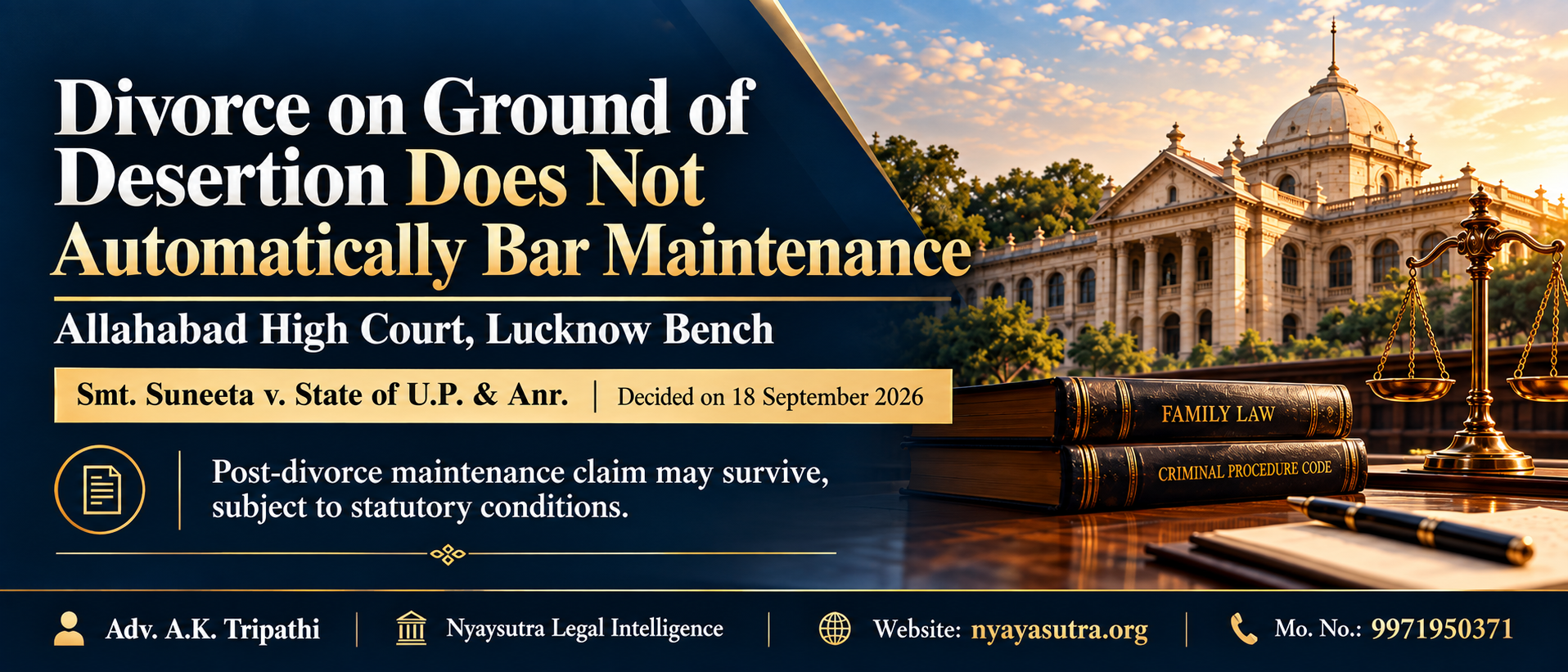
Can a Wife Divorced for Desertion Still Claim Maintenance? Allahabad High Court Clarifies the LawA decree of divorce on the ground of desertion may end the marital relationship, but does it also permanently end a woman’s right to claim maintenance from her former husband?The Allahabad High Court, Lucknow Bench, recently considered this important question in Smt. Suneeta v. State of U.P. & Anr., Criminal Revision No. 254 of 2019, decided on 18 September 2026.
The Court held that a woman divorced on the ground of desertion is not automatically barred from claiming maintenance for the post-divorce period, provided the statutory requirements are otherwise satisfied.The judgment is particularly important because it draws a clear legal distinction between a woman’s position during the subsistence of marriage and her statutory status after she becomes a divorced wife. The High Court relied upon the Supreme Court’s decision in Rohtash Singh v. Ramendri, which recognises this distinction.
The Case Before the High Court
The proceedings arose from a maintenance claim filed under Section 125 of the Code of Criminal Procedure, 1973.Suneeta had sought maintenance for herself and her son. During the pendency of the dispute, her husband obtained an ex parte decree of divorce dated 25 September 2014 on the ground of desertion.Later, the Principal Judge, Family Court, Sultanpur rejected the maintenance petition in its entirety.The wife approached the Allahabad High Court in revision.The question therefore was not merely whether desertion had been established in the matrimonial proceeding. The more important issue was whether that finding could continue to operate even after the marriage had legally ended.Desertion During Marriage and Maintenance After Divorce Are Different QuestionsThis is the central principle emerging from the judgment.Under Section 125 CrPC, a wife could be disentitled to maintenance in certain circumstances. Section 125(4), for example, dealt with a wife who, without sufficient reason, refused to live with her husband.
Such a provision necessarily operates in the context of a subsisting matrimonial relationship.However, the Explanation to Section 125(1) expressly included within the meaning of “wife” a woman who had been divorced by, or had obtained divorce from, her husband and had not remarried.
The legal position therefore changes once the marriage is dissolved.A married woman claiming maintenance and a divorced woman claiming maintenance may arise from the same relationship, but their statutory claims do not rest on precisely the same foundation.The High Court observed that even where divorce had been granted against the wife on the ground of desertion, she could still seek maintenance after the divorce became effective. Indian KanoonThe Supreme Court Principle in Rohtash Singh v. RamendriThe Allahabad High Court placed reliance on the Supreme Court judgment in Rohtash Singh v. Ramendri, (2000) 3 SCC 180.
That case involved a remarkably similar question.The husband had obtained divorce on the ground of desertion by the wife and argued that such desertion should prevent her from receiving maintenance.The Supreme Court rejected the proposition as an absolute rule.It held that the restrictions relating to refusal to live with the husband presuppose the continuation of the marital relationship.Once a decree of divorce is passed, the former wife is no longer under a matrimonial obligation to reside with her former husband.For the limited purpose of maintenance law, she continues to fall within the statutory definition of a “wife”, subject to conditions such as her inability to maintain herself and absence of remarriage. CaseMine This distinction is crucial.The law does not say that desertion becomes irrelevant in every respect. What it says is that desertion cannot automatically operate as a perpetual bar after the marriage itself has ceased to exist.
The Date of Divorce Becomes Legally Significant. In the present case, the divorce decree took effect on 25 September 2014.
The High Court observed that even if the wife was not entitled to maintenance for herself for the period before divorce because of the finding of desertion, she could nevertheless claim maintenance after the dissolution of marriage.This follows the distinction recognised in Rohtash Singh, where the Supreme Court accepted that maintenance for the period preceding the decree of divorce could stand on a different footing from maintenance sought after divorce. Indian Kanoon
That is why the judgment should not be reduced to the simplistic proposition that:
“A wife guilty of desertion is always entitled to maintenance.”That would be incorrect.
The more accurate legal position is: A decree of divorce on the ground of desertion does not, by itself, permanently disqualify a divorced woman from seeking maintenance for the period after divorce.
The Wife’s Financial Position Also Matters
Maintenance is never determined merely by marital status.The claimant must satisfy the applicable statutory requirements.
In Suneeta, the High Court noted that no independent income of the wife had been proved on record and did not interfere with the finding that she was unable to maintain herself. Indian Kanoon The financial capacity of the parties, their income, liabilities and other relevant circumstances therefore remain central to determining the eventual amount of maintenance.This is an important point for litigants as well as practitioners.
Eligibility to seek maintenance and the quantum of maintenance are two separate issues. A person may have the legal right to pursue a maintenance claim, but the amount ultimately awarded will depend upon evidence relating to the financial circumstances of the parties.
Did the High Court Award ₹4,000 as Final Maintenance?
No.
This is one of the most important aspects of the judgment and should be reported accurately. The High Court did not finally determine ₹4,000 per month as permanent maintenance. Instead, it set aside the Family Court order which had rejected the claim and remitted the matter for fresh adjudication. The parties were directed to file affidavits relating to their assets, income and liabilities in accordance with the Supreme Court’s directions in Rajnesh v. Neha, (2021) 2 SCC 324. The Family Court was asked to decide the proceedings afresh, preferably within six months. During the pendency of that rehearing, however, the High Court directed the husband to pay the wife ₹4,000 per month as interim maintenance. Indian Kanoon .The difference between interim maintenance and final maintenance is legally significant.The final amount will be determined by the Family Court after considering the evidence placed before it.
What About the Son’s Maintenance? The High Court also dealt separately with the son’s entitlement. The Court held that the son could claim maintenance until attaining majority, subject to adjustment for periods during which maintenance had already been received through the Army authorities. This portion of the judgment is another reminder that disputes between spouses and a child’s claim for maintenance cannot necessarily be treated as identical questions. Indian Kanoon Why This Judgment Matters to Family-Law Practitioners.The judgment is useful because matrimonial litigation frequently involves several proceedings running simultaneously or successively—divorce, maintenance, domestic violence proceedings, custody disputes and applications for permanent alimony. A finding recorded in one proceeding may certainly have consequences elsewhere. But such a finding cannot automatically be transplanted into another statutory proceeding without examining: What exactly was decided? For which period was it decided?
Under which provision of law? Has the legal status of the parties subsequently changed?
In Suneeta, the answer turned substantially on the change in status brought about by divorce. Before divorce, the parties were husband and wife in a subsisting marriage. After divorce, the claimant stood before the court as a divorced wife recognised by the maintenance statute.
That legal transition matters. Position Under the BNSS. Although the present litigation arose under Section 125 CrPC, the current criminal-procedure framework is governed by the Bharatiya Nagarik Suraksha Sanhita, 2023. The corresponding maintenance provision is Section 144 BNSS. Importantly, Section 144 continues to provide that, for the purposes of the relevant chapter, the expression “wife” includes a woman who has been divorced by, or has obtained divorce from, her husband and has not remarried.
The basic statutory principle considered in Suneeta therefore continues to remain relevant under the present law.
The Larger Legal Principle. Maintenance law is not designed merely to revisit blame arising out of a failed marriage. Its purpose is also to address the financial consequences that may survive the dissolution of the marital relationship. At the same time, maintenance cannot be treated as automatic. The court must still examine the statutory conditions, the claimant’s ability to maintain herself, the respondent’s means and all relevant financial material. The significance of Suneeta lies in maintaining this balance. A finding of desertion may have legal consequences. But it does not necessarily follow that the same finding permanently removes every statutory protection available to a woman once she becomes divorced.
Conclusion
The Allahabad High Court’s ruling reinforces an important but sometimes overlooked distinction in matrimonial law: A divorce decree based on desertion and a post-divorce maintenance claim operate in different legal settings. Desertion may affect rights while marriage continues. Once the marriage has been dissolved, however, the divorced woman’s maintenance claim must be considered in the light of her separate statutory status. The case therefore offers an important lesson for family-law litigation: The end of marriage does not automatically mean the end of every statutory obligation arising from that relationship. What survives, and to what extent, must be determined by the law governing the particular claim.
Case: Smt. Suneeta v. State of U.P. & Anr.
Court: Allahabad High Court, Lucknow Bench
Criminal Revision: No. 254 of 2019
Neutral Citation: 2026:AHC-LKO:65964
Judgment: 18 September 2026
Coram: Hon’ble Justice Ram Manohar Narayan Mishra
Author: Adv. A.K. Tripathi
Nyayasutra Legal Intelligence | nyayasutra.org
Disclaimer: This article is intended for legal information and academic discussion and should not be treated as legal advice for any individual case.
Found this helpful?
Share this article with someone who needs it. Or contact us for a consultation.