
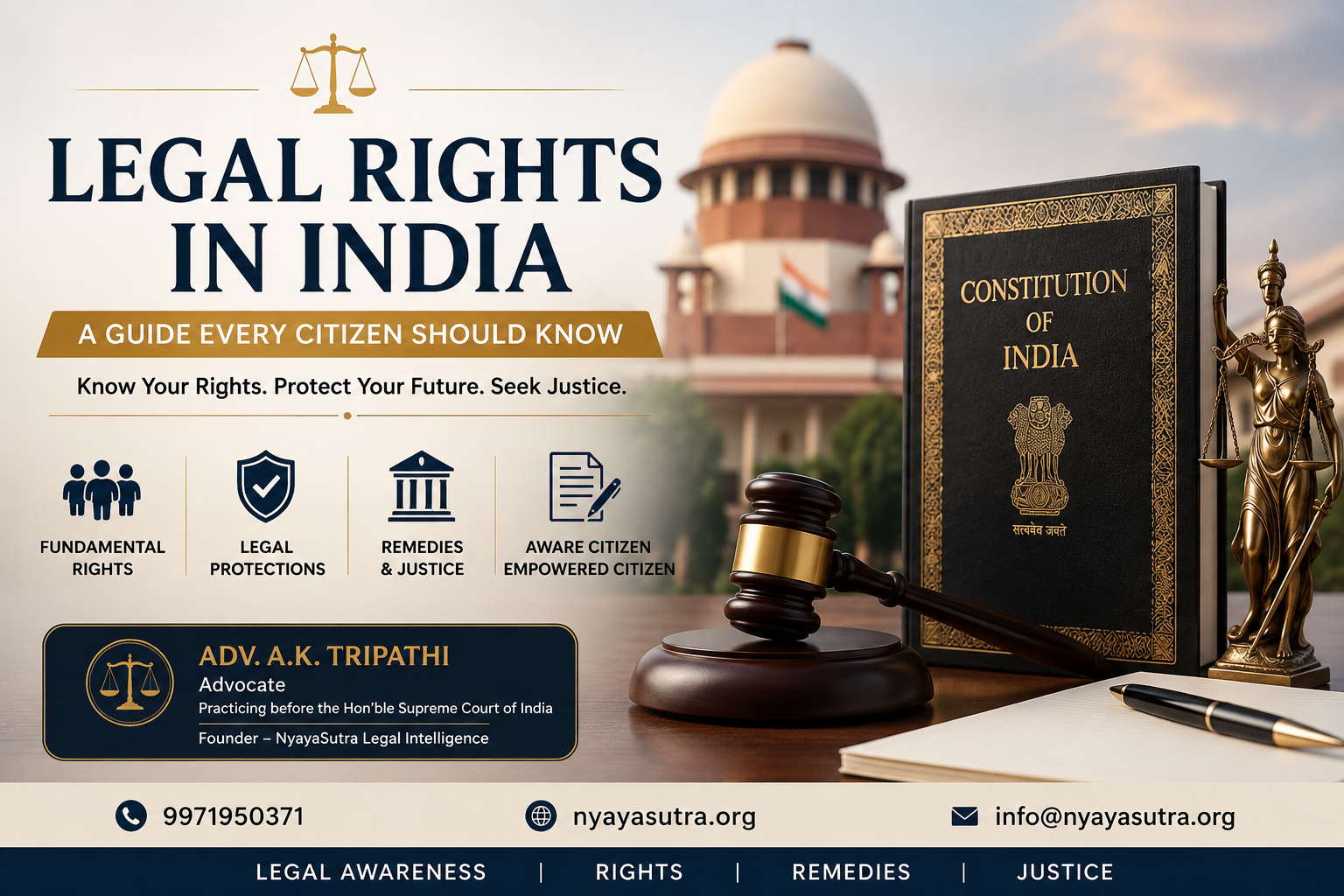
Legal awareness is the first step towards protecting your rights.
In everyday life, a legal issue can arise without warning. A property dispute may arise within a family. A person may receive a legal notice, face online financial fraud, encounter an employment dispute, become involved in a consumer complaint, or find themselves facing proceedings before a court or government authority.
In such situations, lack of legal awareness can sometimes be as serious as the underlying dispute itself.
Many people do not know what their rights are, which authority they should approach, what documents they should preserve, or how quickly they need to act.
This article provides a general overview of important legal and constitutional rights in India and explains why timely legal awareness and professional legal guidance can matter.
Important: This article is for general informational purposes. The legal position in an individual matter depends upon the facts, applicable law, evidence, jurisdiction, and procedural requirements.
Why Legal Awareness Matters
Knowing the law does not mean that every citizen needs to become a lawyer.
Legal awareness means understanding the basic rights and obligations that may affect you, recognising when a legal problem has arisen, preserving relevant evidence, and knowing when professional legal advice may be necessary.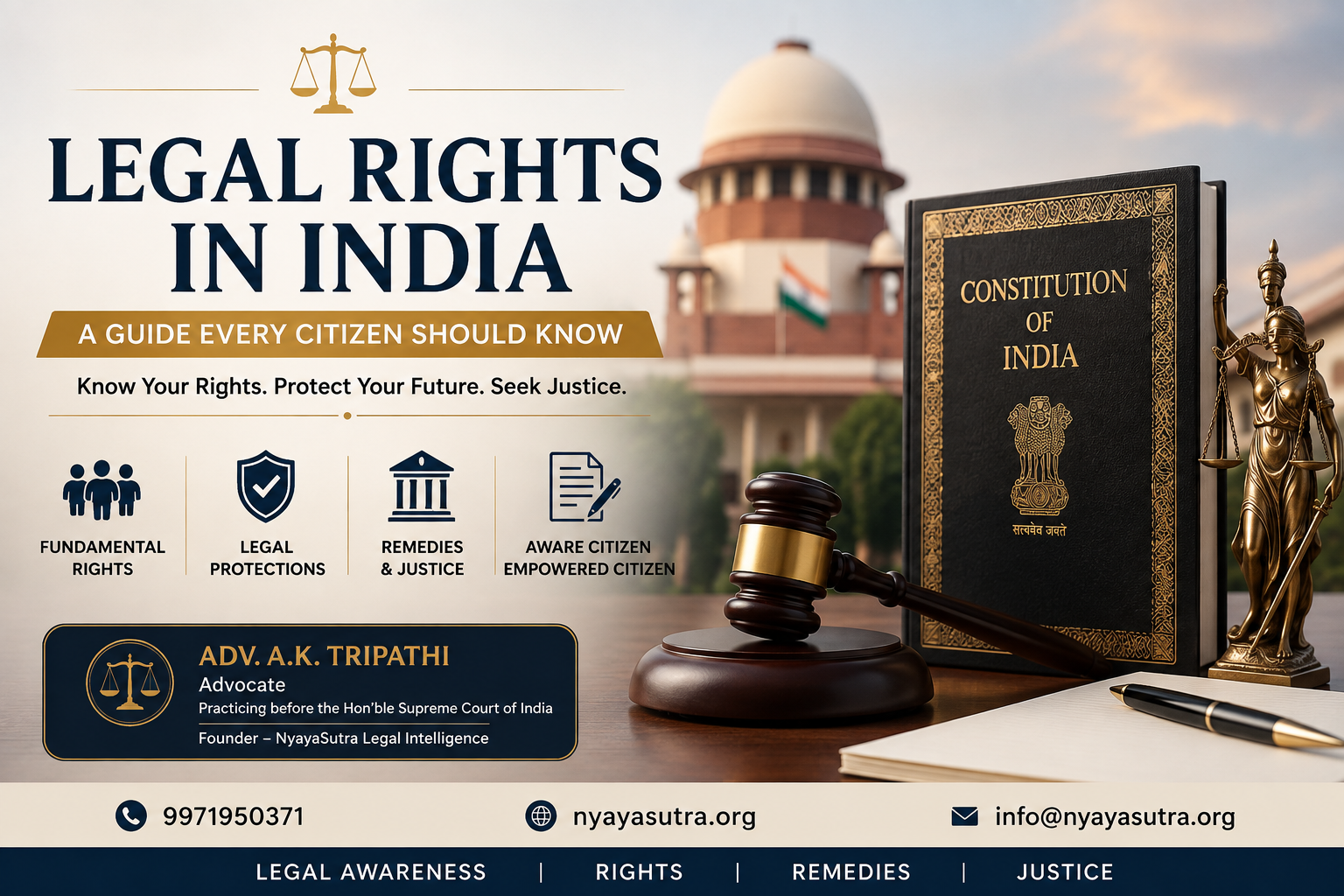
Legal awareness can help a person:
understand and protect their legal rights;
identify appropriate legal remedies;
avoid preventable legal and financial mistakes;
recognise fraud, exploitation, or unlawful conduct;
preserve documents and other evidence;
respond appropriately to legal notices and proceedings;
understand contractual and other legal obligations; and
approach the appropriate court, authority, or forum when necessary.
In many disputes, the most important question is not simply “Who is right?” but also “What is the legally appropriate remedy, where should it be pursued, and within what time?”
Fundamental Rights Under the Constitution of India
Fundamental Rights are among the most important constitutional protections available under Part III of the Constitution of India.
They are primarily contained in Articles 12 to 35.
These rights protect important aspects of equality, liberty, freedom, dignity, and constitutional protection. However, the exact scope of a right and the restrictions applicable to it depend upon the constitutional provision and the facts of the particular case.
1. Right to Equality
Article 14 guarantees equality before the law and equal protection of the laws.
The Constitution also contains specific protections against discrimination. Article 15, for example, prohibits discrimination by the State on specified grounds, subject to constitutionally permitted provisions and exceptions.
The principle of equality is an important safeguard against arbitrary State action and unequal treatment.
2. Right to Freedom
Article 19 guarantees specified freedoms to citizens, including freedom of speech and expression, peaceful assembly, association, movement throughout India, residence in any part of India, and the freedom to practise a profession or carry on an occupation, trade, or business.
These freedoms are subject to constitutional limitations and reasonable restrictions prescribed by law.
Accordingly, the existence of a constitutional freedom does not mean that every exercise of that freedom is unrestricted.
3. Right Against Exploitation
The Constitution also provides important protections against exploitation.
Article 23 prohibits trafficking in human beings and forced labour.
Article 24 prohibits the employment of children below fourteen years of age in factories, mines, or other hazardous employment.
These provisions reflect the constitutional commitment to human dignity and protection from exploitative practices.
4. Right to Constitutional Remedies
A right is meaningful only when an effective legal remedy is available for its enforcement.
Article 32 provides a constitutional remedy before the Supreme Court for the enforcement of Fundamental Rights.
Article 226 empowers High Courts to issue writs and appropriate directions, orders, or writs for enforcement of Fundamental Rights and, subject to the constitutional framework, for other legal purposes as well.
The appropriate constitutional remedy depends upon the facts of the case, the nature of the right involved, the authority against whom relief is sought, and other legal and procedural considerations.
Legal Rights Are Wider Than Fundamental Rights
A common misunderstanding is that all legal rights are Fundamental Rights.
That is not correct.
Fundamental Rights are constitutionally protected rights contained principally in Part III of the Constitution. In addition, individuals have numerous statutory, contractual, property, civil, procedural, and other legal rights arising under different laws.
Depending upon the circumstances, legal issues may involve:
property and land rights;
succession and inheritance;
family and matrimonial matters;
employment and service disputes;
contractual and commercial disputes;
consumer rights;
cybercrime and online fraud;
criminal proceedings;
banking and financial disputes;
environmental matters;
regulatory proceedings; and
disputes involving government authorities.
The applicable law and remedy will depend upon the facts and circumstances of the particular matter.
What Should You Do When You Face a Legal Problem?
When a legal dispute arises, the first step should be to remain careful and preserve the relevant information.
Preserve Your Documents
Depending upon the nature of the matter, preserve:
agreements and contracts;
property and revenue records;
legal notices;
court orders;
government communications;
receipts and payment records;
emails and messages;
photographs and videos;
digital records;
employment documents; and
other material relevant to the dispute.
Do not alter, destroy, or fabricate evidence.
Do Not Ignore Formal Legal Communications
If you receive a legal notice, summons, complaint, order, or communication from a government authority, do not simply ignore it.
Carefully determine:
Who issued the communication?
What is the allegation or claim?
Which law or provision has been referred to?
What response is required?
Is there a deadline?
Is any proceeding already pending?
Where the matter is legally significant, the document should be reviewed by a qualified advocate before taking substantive action.
Why Timely Legal Advice Can Matter
Legal proceedings are governed by laws, procedures, jurisdictional requirements, and in many cases limitation periods.
Delay may sometimes affect a person's legal position.
For example, a person may have an otherwise arguable claim but face difficulty because relevant documents were not preserved, the wrong forum was approached, a statutory deadline was missed, or an important legal step was not taken in time.
A timely consultation with an advocate can help in:
identifying the relevant legal issues;
examining documents and evidence;
understanding possible remedies;
determining the appropriate forum;
assessing procedural requirements;
preparing a legal notice or response where appropriate; and
considering litigation or alternative dispute-resolution options.
Importantly, legal consultation does not necessarily mean litigation.
Depending upon the circumstances, negotiation, mediation, arbitration, statutory remedies, or other lawful mechanisms may also be considered.
Common Areas Where Legal Awareness Is Important
Property and Land Disputes
Property disputes may involve title, possession, inheritance, registration, revenue records, mutation, agreements, limitation, or competing claims.
Before entering into a significant property transaction, proper document verification and appropriate legal advice can help identify potential issues.
Cyber Fraud and Online Financial Fraud
Digital transactions have created new forms of legal risk, including phishing, identity theft, unauthorised transactions, impersonation, and other cyber offences.
Where a person becomes a victim of cyber fraud, preserving transaction details, messages, screenshots, emails, account records, and other relevant digital evidence can be important.
Family and Matrimonial Matters
Family disputes can involve divorce, maintenance, custody, domestic violence, succession, inheritance, or other legal issues.
Because these matters often involve sensitive personal and financial consequences, legal advice should be based on the specific facts rather than general assumptions.
Employment and Service Matters
Employment disputes may involve termination, disciplinary proceedings, salary, contractual obligations, service conditions, or other workplace issues.
The appropriate legal remedy may depend upon the nature of employment, applicable service rules, contractual terms, and the relevant statutory framework.
Consumer Disputes
Consumers may have remedies in appropriate cases involving defective goods, deficient services, unfair practices, or other violations recognised under applicable consumer law.
The correct forum and remedy depend upon the nature of the dispute and applicable law.
Access to Legal Aid
Access to justice is an important constitutional principle.
Article 39A directs the State to promote equal justice and provide free legal aid so that opportunities for securing justice are not denied because of economic or other disabilities.
India has a legal services framework through institutions including the National Legal Services Authority (NALSA), State Legal Services Authorities, and District Legal Services Authorities.
However, eligibility for free legal services depends upon the applicable legal provisions and the individual's circumstances.
A person who believes they may qualify for legal aid should approach the appropriate Legal Services Authority for information regarding eligibility and available assistance.
When Should You Consult an Advocate?
Professional legal advice should be considered particularly where the matter involves:
substantial property or financial interests;
a legal notice or court summons;
a pending criminal proceeding;
arrest or threat of arrest;
a serious family or matrimonial dispute;
employment or service consequences;
contractual or commercial disputes;
constitutional or administrative issues;
regulatory proceedings;
significant cyber or financial fraud; or
any situation in which delay could materially affect your legal rights.
The earlier the facts and documents are properly examined, the easier it may be to identify the available legal options.
Legal Awareness Is Not a Substitute for Legal Advice
General information available on websites, social media, videos, or other online sources can help a person understand legal concepts.
However, online information cannot examine the complete facts and documents of an individual case.
Two cases may appear similar but may have completely different legal outcomes because of differences in evidence, jurisdiction, limitation, contractual terms, procedural history, or applicable law.
Therefore, general legal information should be treated as a starting point—not as a substitute for case-specific professional advice.
About Adv. A.K. Tripathi
Adv. A.K. Tripathi is an Advocate practicing before the Hon’ble Supreme Court of India and the Founder of NyayaSutra Legal Intelligence.
NyayaSutra Legal Intelligence is a legal platform focused on legal research, strategic legal analysis, professional consultation, and solution-oriented assistance.
The practice and professional assistance cover matters including:
Constitutional Law
Civil and Commercial Disputes
Criminal Litigation
Property and Land Disputes
Family and Matrimonial Matters
Service Matters
Arbitration
Regulatory Proceedings
Consumer Matters
Cyber and Technology-Related Legal Issues
Proceedings before Courts, Tribunals, and Quasi-Judicial Authorities
Matters may be handled before the Hon’ble Supreme Court of India, High Courts, District Courts, and appropriate judicial and quasi-judicial forums, depending upon the nature, jurisdiction, and requirements of the matter.
Legal Consultation & Case Enquiry
If you are facing a legal issue and require professional legal guidance, you may contact Adv. A.K. Tripathi / NyayaSutra Legal Intelligence for a consultation or case enquiry.
Contact Details
Adv. A.K. Tripathi
Advocate
Practicing before the Hon’ble Supreme Court of India
Founder — NyayaSutra Legal Intelligence
Phone: 9971950371
Website: nyayasutra.org
Found this helpful?
Share this article with someone who needs it. Or contact us for a consultation.